Metroid Prime:Hunters review
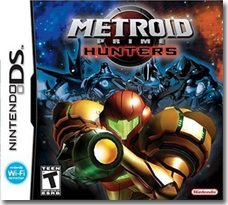
Metroid Prime Hunters
Category: First Person
Release: March 20, 2006
Publisher/Developer: Nintendo
Up to 4 players, WiFi compatible
Rated T for Teen
Website • Game Page • WiFi Gaming Hub
The race is on to become the most powerful hunter in the galaxy! Metroid Prime Hunters is Nintendo’s exciting new DS game with multiple game modes, characters, and virtually endless fun. Samus and six never before seen bounty hunters all embark on the same mission: to find the ultimate power hidden within the mysterious stretch known as the Alimbic Cluster. In one of the galaxy’s most technologically advanced rat races ever, anything can happen. Familiar Metroid elements clash with ones all anew, and with Nintendo WiFi Connection, the Metroid universe finally unites in one of the Nintendo’s finest displays of handheld gaming goodness.
Following the Metroid timeline, you can pinpoint Hunters between the stories of Metroid Prime and Metroid Prime Echoes. In case you don’t know what this means, Samus has supposedly defeated the phazon-infested creature known as Metroid Prime, which could also mean the phazon matter itself may have been destroyed. Now, most of us know that phazon returns in Metroid Prime 2 in the form of Dark Samus, but the Hunters mission takes place before that.
As the story tells it, there once lived a powerful, yet peaceful race known as the Alimbics. They were highly advanced and prospered over their land, the Alimbic Cluster. But one day, their time was done, and evacuated the land, leaving behind all their precious artifacts, protected by a seemingly invincible weapon arsenal. The Cluster stayed inactive and out of the galaxy’s site for many centuries. It was only just recently that activity resurrected in the land, when it sends telepathic messages into the brains of some of the galaxy’s finest bounty hunters. The message was received in many different languages, but it’s message bared the same signal for all:
”The secret to ultimate power lies in the Alimbic Cluster.”
The hunters, Trace, Spire, Weavel, Sylux, Noxus, and Kanden, immediately set their destination toward the Cluster in hopes of finding this majestic power. Each hunter has different intentions, though. Some want it for themselves or their planet. Others desire power and greed to prove their weight in being the strongest hunter in existence. Our e, Samus Aran has been notified of the situation and sent to investigate the Alimibic Cluster. Mission objective: discover the “hidden power”, and capture it before the wrong hands are able to leave their prints on it.
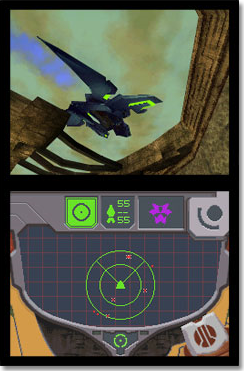
Sylux reporting for duty...
Metroid Prime Hunters has two modes: Adventure (single) and Multiplayer. Simple enough, right? Adventure will send you full speed ahead into another classic Metroid tale similar to the previous two Prime games. For the first time, though, you’ll gain control of Samus’ ship. This is where you’ll scan the surface of the Alimbic Cluster in search of plans to land. You won’t be able to fly the ship like many had wanted, but it’s still pleasing to finally see a first person view inside Samus’ shelter.
It may take a while to grasp the fashion of playing a first person shooter on a handheld system, but you should be able to get used to it rather quickly. Metroid Prime Hunters certainly provides an ample comfort level for those slow to grasp it by starting preliminary and increasing in difficulty as you learn. While some have accused this game of straying too far away from Metroid’s traditional gameplay, there is simply no doubt about this statement’s falsehood. You’ll be scanning, , charging, finding items, rolling in the morphball, and straining your brain with numerous room puzzles. This is probably the closest Nintendo could make Hunters to the other Metroid games without it being a complete duplicate.
This game does begin a new theme in the Metroid franchise, however. Hunters is the first game in the Metroid series that has it’s levels broken up and divided into objectives, each ending in a boss battle. This is another issue critical issue commonly blustered by fans. Anyone who has tried their luck in a previous Metroid title knows that the standard in gameplay is start-to-finish, without any pauses or coffee breaks. From a non-devoted gamer’s standpoint, this is not really an issue. The same Metroid gameplay is prompt, just presented in a different way.
With traditional Metroid gameplay as its foundation, Hunters begins to stray on its own with some new gameplay elements. You really cannot accurately predict what is going to happen next, because each level in this game poses the threat of new challenges and environments. You may cross paths with old enemies such as zoomers, war wasps, and of course, metroids, but the rest is all up to you to uncover on your own.
Similar in the way of what a power-up meant after beating bosses in previous games, octoliths are your sign of completing a level in Hunters. After every boss battle, an octolith will be released, which transmits another telepathic message into Samus’ mind. This message is just one more clue on what the ultimate power is and where you should look to find it.
And then, of course, there is Nintendo WiFi Connection, the game mode 90% of you folks probably jumped into immediately. There’s no shame in that, right? None at all, because this mode is simply fantastic. Nintendo’s first dive into online video gaming was with Mario Kart DS, but from a technical standpoint, it may very well have been considered a belly flop. The gameplay was filling, but bare bone standards were used in creating an interactive online structure for gamers. Nintendo didn’t make the same mistakes a second time, luckily for us.
The first major change Nintendo made was the creation of lobby and room options for friend code-connected players. Connecting with one another was usually spontaneous and varying with success in Mario Kart due to its lack of rooms to join. Metroid Prime Hunters boasts rooms for its players where gathering is only made easier. Still, connection issues are very apparent when multiple people attempt to join a room. Overall, the room system is a key improvement in Nintendo’s WiFi system.
To then bridge the complete lack of communication known before in Mario Kart, there’s voice chat! While in the room of a game, players can hold down X, speak into the Nintendo DS’ built-in microphone, and finally interact with another. This proves very handy in discussing game options. And for those who just happened to contract a major case of laryngitis and cannot speak (cowards), there is also a text-based chat system. Nintendo’s blind gaming is officially , and not likely to return thanks to the nce of the voice chat feature.
Finally, a seemingly brilliant way of punishing sore losers was put in effect for this game. As with several other statistics, your connection percent is tracked. Remember all those disconnecters who turned off their DS after you won the third race in Mario Kart? Well, now there is a connection rate, or how often you stay in a game without disconnecting midway. Your connection rate starts at 100% and declines after every disconnection. Nintendo planned for this to be a way of spotting beat gamers, but sadly, did not follow through. To quote Rich Vorodi, a Nintendo Software Technology game designer, he says this:
”Before you start a game with someone you can see the Connection Percentage and decide if you want to play with that person.” - Note: You can view the article I quoted HERE.
From what I have seen in Hunter’s current online play, this is a false statement. Connection percentage is logged, but there is no such way of viewing one’s history in disconnects. In a way, it makes having this statistic logged completely pointless, but I suppose it encourages people to tough out a full game, regardless of how badly they are getting whipped.
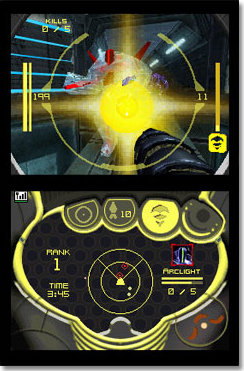
It’s merciless blows like this that may trigger your opponents to disconnect.
The actual online gameplay is marvelous. Several different game modes, the ability to toggle game settings, and scarce cases of lagging gameplay are just a few of the aspects to promote this. Participating in a non-friend game does not allow you to make custom settings. A worldwide or regional game has the fixed settings of first to seven wins or after seven minutes expires, whichever comes first. When either of these outcomes are reached, the game ends, the results are displayed, and you’ll have the option of adding the user to your rival list or playing again, of course.
Another case to plead is the overwhelming abundance of arenas to choose from, and their structure. There are over twenty-five areas categorized by their size. If you’re looking for some head-to-head tests of survival, play in the Combat Hall. Or if you’d like some room to spread out in, where you can carefully throw down your long distance snipes? Choose the Alinos Gateway. The standard voting procedure still applies though. You vote for the arena you’d like to battle in, your opponents do the same, and a random course is picked unless there is a majority.
Items are spilled all over the place in every level, giving you a decent chance at finding your favorite weapon, restoring some health, or getting sweet upgrades. They typically respawn after a few seconds except if they are very powerful, in which case several minutes can pass before you see another one. When you wreck an opponent, any items they had in their inventory will be left behind and available for the taking. This means you could use another hunter's beam you wouldn't normally be able to possess.
In Adventure mode, whenever you defeat a hunter or gain access to a new level, it is unlocked and available for play on WiFi Connection. However, in case you didn’t want to rack up the hours or spend a little extra time unlocking all of these, Nintendo has smiled upon you. To unlock something you previously did not have in WiFi, all you need to do is win a match against an unlockable hunter or win in an arena you didn’t have before. It will then be permanently added to your list and available every time you play. In a productive night, you could probably unlock everything to boost your number of online gameplay options. Nifty, eh?
There is the issue of controls, which greatly affect your gameplay experience. To be perfectly honest, they’re abysmal. There are four predetermined control settings to choose from, two using the stylus, and the other using the buttons. Whoever thought touch screen controls would ever be able to work in a game as hectic and intense as Hunters ought to be fired. There is just no grasping this control setting. Stylus controls are the default setting too, so first time players may immediately start disliking the game because of how crazy it is to control. The two dual modes are the only user-friendly control settings, but even they take some time to get used to. Now, I understand my microrant about the controls seems opinionated, but I’m sure one thing we can all agree on is that being able to select custom controls would greatly benefit everyone’s enjoyment of the game. Everyone has a different preference, and maybe Nintendo should have realized that, especially with their first handheld FPS.
So we’ve covered just about everything in terms of gameplay, but it kills me to have graphics this far down in the review. Hunters’ graphics…are absolutely amazing. The cutscene quality will astound you, and there’s not a loss of them either. Whether it is the masterful opening scene, prologue to a boss, or common camera pans, this game is as much of a cinematic pleaser as it is an adventure. Nintendo really stepped out and delivered an unbelievable graphic performance. The only other game I can think of that comes close to matching the graphics of Hunters is Meteos’ opening scene, but that was only one. Hunters has riveting cutscenes from start to finish. One of the most notable graphic achievements is the detail on the bottom screen. If you notice, each hunter has his own individually detailed menu panel. To me, it’s little things like this that set games’ quality apart from others.
If you listen closely, you can almost hear your DS screaming for help…
We’ve seen some incredible sound quality on the Nintendo DS from the likes of Metroid Prime Pinball, Tony Hawk’s American Skateland, and Mario and Luigi: Partners in Time. More excellent audio arrangements have been put forward in Hunters. The main music theme, as always in Metroid games, is a dark, sci-fi-like aria reflected in every level you’ll encounter. The soundtrack fits in pretty well with the rest of the series as well, sometimes adopting older Metroid songs, remixing them or presenting them differently.
In the ever continuing saga of DS games with incredibly high replay value, Metroid Prime Hunters fits in swimmingly. If you’re like me, bored of Mario Kart, and have pretty much accomplished everything possible in Animal Crossing, this is the next turn in the road for limitless entertainment. Like the others, getting tired of this game will certainly require several months of actively playing. Single player adventure can only keep you entertained for so long, but with WiFi and it’s connection to NintendoWiFi.com, somehow I can see myself playing this game a year from now in perfect comfort.
With Metroid Prime Hunters now under Nintendo’s belt, the sky is the limit for them to continue pushing our known standards of video game nce in the future. This game really achieved several turning points not only for the company, but for the Metroid series itself. I can only imagine how positively the Metroid games of the future will be influenced by this title. The Metroid Prime subseries will reach its conclusion with the release of Metroid Prime 3 for the Revolution, but big things are in store for Samus’ next 3d plights.
Nintendo didn’t just break the ice with their first attempt at a handheld shooter, they shattered it.
Wrap-up
Gameplay: Stellar. It is unimaginable how Nintendo could have ported Metroid Prime to the Nintendo DS any better than they did. Weapon upgrades and powerups, unlockables level design, fierce combat, and magnificent WiFi capabalites are all major reasons why this gameplay is unmatched. Difficulty with grasping the controls seems to be the one major and probably most downgrading aspect of the game. Lack of custom controls and nearly impossible control settings as default took from the enjoyment of this game. 9.0/10.
Graphics: Unmatched by any previous Nintendo DS game to date. Brilliantly tailored cutscenes, pure level detail, and creative methods of making more appealing menus and options are pluses. Sometimes, these graphics are prone to causing minor lag in certain spots, though. 9.5/10.
Sound/Music: Brilliant. It’s quite challenging to predict when Nintendo’s innovative handheld music quality will ever stop growing, because it just seems like it gets better after every new release. Fitting music and suitable sound effects help create a more realistic environment for the game to take life in. 9/10
Replay Value:Limitless. Mario Kart had it’s linearity, Animal Crossing grew dull with age, but Hunters is likely to be the one that outweighs the other two in this category. Adventure can be taken down in different ways, but the WiFi play is what will reel in many gamers for an extended period of time.
Overall: Best DS game to date, in my opinion. It just shines in so many different ways, and is a game so many have waited for through the years. Well, it’s finally here, let us celebrate and rejoice. 9.5
Review by SUPERMETROIDISTHEBESTGAME of the Nsider forums.
posted by Bryce @ Monday, March 27, 2006
23 comments